Google AI Overviews in 2026: Changes, Usage Statistics and SEO Impact
Originally published February 18, 2026. Updated August 2026.
Google AI Overviews have become a prominent part of the search experience, but their impact is more nuanced than “AI is replacing SEO.”
Recent data shows that AI Overviews can reduce organic click-through rates, increasingly appear for commercial searches, and coexist with Google Ads more frequently. At the same time, Google continues adding conversational, personalized, and multimodal capabilities to Search.
For brands, this changes what successful SEO looks like. Rankings and organic traffic still matter, but businesses must also measure AI visibility, citations, qualified visits, branded demand, and conversions.
Google AI Overviews in 2026: Key Findings
AI Overviews are available in more than 200 countries and territories and over 40 languages.
An Ahrefs study found that the presence of an AI Overview correlated with a 58% lower CTR for the page ranking in position one.
Semrush found that AI Overviews for commercial-intent queries increased 71% during a six-month study.
Google Ads and AI Overviews now appear together approximately twice as often as they did one year earlier.
The percentage of searches showing AI Overviews varies significantly by industry, intent, country, device, dataset, and measurement date.
Google does not require special AI schema or a separate optimization process. Its standard technical and content SEO requirements still apply.
What Are Google AI Overviews?
Google AI Overviews are generative summaries displayed in Google Search for queries where Google determines that an AI-generated response may help users understand a topic or explore it more deeply.
Instead of showing only traditional organic listings, Google may generate an answer using information supported by several web sources. The result can include citations, expandable links, images, product information, follow-up questions, and other interactive elements.
AI Overviews do not appear for every search. Their presence depends on the query, intent, market, device, available information, and whether Google determines that a generative response adds value.
According to Google’s guidance for AI features and websites, there are no additional technical requirements or special schema types needed to appear in AI Overviews. A page must follow Google Search’s existing technical requirements and SEO best practices.
What Changed in Google AI Overviews in 2026?
Google AI Overviews evolved from static summaries into a more conversational search experience during 2026.
In January, Google announced that Gemini 3 would become the default model powering AI Overviews. The company also introduced the ability to ask follow-up questions directly from an AI Overview, creating a more seamless transition between a traditional search result and an AI-led conversation. These changes are explained in Google’s official AI Mode and AI Overviews update.
Google has also expanded personalization through connected services and Personal Intelligence. Depending on availability and user permission, AI-powered search experiences can incorporate context from services such as Gmail, Google Photos, and other connected applications.
These developments mean that search journeys may become longer and more personalized even when users conduct fewer separate searches. Brands must prepare content for complex questions, comparisons, follow-ups, and decision-making—not only isolated keywords.
Google AI Overviews Usage Statistics
The following findings provide a clearer picture of AI Overview adoption and search impact:
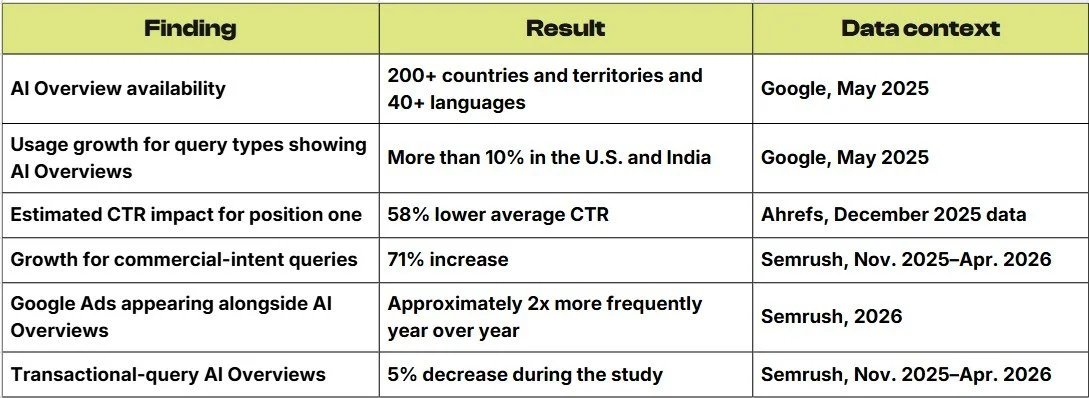
Google reported that AI Overviews had expanded to more than 200 countries and territories and were increasing Search usage by more than 10% for the query types where they appeared in large markets such as the United States and India.
These figures should not be interpreted as the percentage of all searches showing an AI Overview. Availability, usage, query coverage, and SERP frequency are different measurements.
What Percentage of Searches Show AI Overviews?
There is no single, reliable percentage that applies to every Google search.
Third-party studies measure different keyword databases, industries, countries, devices, and search intents. Their results can therefore vary substantially.
For example, Semrush reported that AI Overviews appeared for 6.49% of the keywords in its tracked dataset in January 2025, increased to nearly 25% in July, and declined to 15.69% in November. These percentages describe the study’s keyword sample—not every Google search worldwide. The full context is available in Semrush’s AI Overview research.
This volatility is important. A website can lose impressions because:
Its organic position declined.
An AI Overview began satisfying more of the search journey.
Google stopped showing an AI Overview for certain queries.
Search demand changed.
Google changed which sources or pages it displayed.
The page lost relevance for related long-tail searches.
For this reason, businesses should avoid relying on one universal AI Overview percentage. Visibility should be evaluated at the website, page, query, country, and device level.
Do AI Overviews Reduce Organic Clicks?
AI Overviews can reduce organic clicks, particularly for informational searches that can be answered directly within the results page.
Ahrefs analyzed 300,000 keywords and found that, using December 2025 data, the presence of an AI Overview correlated with a 58% lower average CTR for the page in position one. The effect became smaller (but remained negative) across positions two through ten. You can review the methodology in Ahrefs’ updated AI Overview CTR study.
This does not mean every website will lose 58% of its traffic. The outcome depends on the query, industry, SERP layout, organic position, brand recognition, and whether users need additional information after reading the generated answer.
It is also incorrect to assume automatically that fewer clicks produce higher-quality traffic. That must be verified using analytics.
Brands should compare:
Organic clicks and CTR.
Engaged sessions.
Leads and purchases.
Conversion rate.
Assisted conversions.
Branded searches.
AI citations and mentions.
Revenue or lead quality by landing page.
This reflects the broader shift toward zero-click search experiences, where visibility can influence a customer before a website visit occurs.
How Are AI Overviews Expanding Into Commercial Search?
AI Overviews are no longer limited primarily to basic informational questions.
A 2026 Semrush study of more than 600,000 U.S. desktop keywords across ten industries found that AI Overviews appearing for commercial-intent queries increased by an average of 71% between November 2025 and April 2026. Meanwhile, transactional-query appearances decreased by 5%.
The same research found that Google Ads and AI Overviews appeared together approximately twice as often as they had one year earlier. The findings are detailed in Semrush’s commercial search study.
For businesses, this means SEO and paid advertising increasingly share the same AI-driven results page. Organic authority can support discovery and consideration, while paid campaigns can capture demand when customers move closer to taking action.
The objective is not simply to occupy more space. SEO, content, landing pages, creative, paid media, and conversion tracking should communicate one consistent value proposition throughout the customer journey.
How Does Google Select Links for AI Overviews?
Google has not published a formula or separate ranking system that guarantees inclusion in an AI Overview.
AI features may use a query-expansion technique sometimes described as “query fan-out,” conducting several related searches across subtopics and data sources before assembling a response. This can expose users to pages that might not have appeared for the original wording of the query.
However, the fundamentals remain familiar. Important pages should be:
Crawlable and indexable.
Available without restrictive robots directives.
Relevant to the user’s intent.
Accurate and supported by reliable evidence.
Clearly written and logically organized.
Connected through descriptive internal links.
Supported by appropriate images, videos, or structured data where relevant.
Structured data can help Google understand eligible page information, but schema does not guarantee an AI Overview citation. Markup must also match content visible to users.
A clear brand entity may help search systems connect an organization with its services, authors, locations, and expertise. Our guide to entity SEO and brand visibility explains how those relationships can be strengthened without treating entity optimization as a shortcut.
How Should Content Be Structured for AI Overviews?
There is no mandatory “AI Overview format,” but clear organization helps readers and search systems understand a page.
Effective content commonly includes:
A concise answer near the beginning of each major section.
Descriptive, question-based headings where appropriate.
Tables that summarize comparable facts.
Lists for processes, requirements, or recommendations.
Specific statistics with publication dates and original sources.
Examples that demonstrate first-hand knowledge.
Clear distinctions between facts, opinions, and inferences.
Meaningful internal links to supporting pages.
Avoid stretching a simple answer into hundreds of words or publishing many near-identical articles. Google recommends prioritizing accuracy, quality, relevance, and original value when using AI-assisted content.
For a deeper implementation framework, see our guide to structuring content for Google AI Overviews.
Are Keywords Still Important for AI SEO?
Yes. Keywords remain valuable because they reveal the topics, terminology, questions, and intentions behind search behavior.
What has changed is how those keywords should be used. A page should not repeat one phrase mechanically. It should answer the primary query and the related questions a user may ask next.
An article targeting “Google AI Overviews statistics,” for example, should also explain:
What changed during the year.
How frequently AI Overviews appear.
How the percentage is calculated.
How they affect CTR and traffic.
Whether their presence varies by industry.
How businesses can measure their own visibility.
This transition from isolated phrases to connected search journeys is explored in our article SEO 2026: From Keywords to Conversations.
How Can Brands Improve AI Overview Visibility?
Businesses should focus on practices that improve their visibility throughout Google Search, not on supposed AI-ranking tricks.
Start with these priorities:
Confirm that important pages are crawlable, indexable, canonicalized, and internally linked.
Match each page to a clear search intent.
Answer important questions directly before adding supporting detail.
Add original research, expert commentary, examples, or first-party data.
Cite primary sources and identify when each statistic was collected.
Maintain consistent organization, service, author, and location information.
Update time-sensitive content and display the modification date.
Connect informational content to relevant commercial pages.
Track engagement, leads, revenue, citations, and brand visibility—not rankings alone.
Test visibility across different queries, platforms, countries, and stages of the customer journey.
Google’s standard search requirements still apply. AI visibility should be treated as an extension of strong SEO and useful content, not as a replacement for them.
How Can You Measure AI Overview Performance?
Begin with Google Search Console by comparing pages, queries, impressions, clicks, CTR, and average position before and after meaningful changes.
Google has also introduced dedicated generative AI performance reporting for a subset of Search Console properties. Where available, these reports provide visibility into pages, countries, devices, dates, and impressions within generative AI features.
Because reporting capabilities may vary, combine Search Console with:
GA4 landing-page and conversion data.
Branded search trends.
Manual prompt testing.
AI visibility platforms.
Server or referral data.
Lead-quality and revenue reporting.
A drop in impressions does not automatically indicate a technical problem. It may reflect ranking losses, changing demand, different AI Overview coverage, or reduced visibility across long-tail queries. You can fin more tools. You can find more AI visibility measurement tools in our complete guide.
What Google AI Overview Data Means for SEO
AI Overviews are not eliminating SEO. They are expanding the number of surfaces and interactions that influence discovery.
The strongest strategy combines technically accessible pages, original information, clear content, recognized expertise, consistent brand signals, and measurement tied to business outcomes.
Brands should continue pursuing rankings and qualified organic traffic while also evaluating whether they are mentioned, cited, trusted, and selected throughout AI-assisted search journeys.
Prepare Your Brand for AI-Driven Search
Searches Everywhere helps businesses improve visibility across Google Search, AI Overviews, LLMs, paid media, and other discovery platforms.
Explore our Search Everywhere Optimization services to identify where your brand appears, where competitors are gaining visibility, and which improvements can generate qualified demand.
To request an SEO or AI visibility assessment, email seo@searcheseverywhere.com or lauren@searcheseverywhere.com.
FAQs
What are Google AI Overviews?
Google AI Overviews are generative summaries that appear in Google Search when Google determines that an AI-generated response can help users understand or explore a query. They may include information supported by multiple web sources, citation links, images, follow-up questions, and other interactive elements.
What percentage of searches show Google AI Overviews?
There is no universal percentage. Results vary according to the dataset, date, industry, country, device, and intent being measured. Third-party percentages should be presented with their methodology and should not be interpreted as representing every Google search.
Do AI Overviews reduce organic traffic?
They can reduce CTR and clicks, particularly for informational searches answered directly in the results page. The effect varies by query and organic position. Businesses should evaluate clicks together with engagement, conversions, leads, and revenue.
How can a website appear in Google AI Overviews?
There is no guaranteed method or special AI schema. Pages should be crawlable, indexable, relevant, accurate, helpful, clearly structured, and supported by strong internal linking and reliable evidence. Google’s normal Search requirements continue to apply.
Are keywords still relevant for AI SEO?
Yes. Keywords reveal demand, language, and search intent. However, pages should address the complete topic and related follow-up questions instead of repeating exact-match phrases.
How should businesses measure AI SEO performance?
Track organic impressions, clicks, rankings, AI-feature visibility, citations, branded searches, engagement, leads, assisted conversions, and revenue. The appropriate metrics depend on whether the page supports awareness, consideration, or direct conversion.